
Why Fresh Features Matter for AI
Building AI models often feels like a two-stage rocket. First, you train a model on historical data. Then, you deploy it to make predictions on new, unseen data. The annoying part is when the data used for training doesn't quite match the data available at inference time. This gap, often called training-serving skew, can silently degrade model performance.
Traditional feature engineering often involves batch processing. You might compute features once a day, or even once an hour. That's fine for many use cases. But what if your model needs to react to user behavior within milliseconds, or identify fraud in real-time? A feature that's an hour old might as well be ancient history. This is where the idea of 'real-time' features comes into play, demanding a different approach to data architecture.
The Core Idea: A Feature Store
Before diving into real-time, it's worth quickly touching on what a feature store is. Think of it as a centralized registry and serving layer for machine learning features. Instead of every data scientist or model re-implementing feature logic, a feature store provides a consistent way to define, store, and retrieve features for both training and inference.
It typically has two main components:
- Offline Store: A data warehouse or data lake (like S3, BigQuery, Snowflake) for historical features, used for model training.
- Online Store: A low-latency database (like Redis, DynamoDB, Cassandra) for serving features during real-time inference.
The goal is consistency: the feature user_last_5_purchases_value should be calculated and stored exactly the same way whether you're training a model or serving a prediction.
Real-time: The Streaming Data Connection
Now, add the 'real-time' requirement. To get fresh features, you can't wait for hourly batch jobs. You need to process data as it arrives. This means connecting your feature store to streaming data architectures.
Imagine a user event stream from an e-commerce site: clicks, views, adds-to-cart. For a real-time recommendation model, you might need features like 'user's average product price in the last 5 minutes' or 'number of unique categories viewed in the last 30 seconds'. These features are constantly changing and need to be computed and updated with minimal latency.
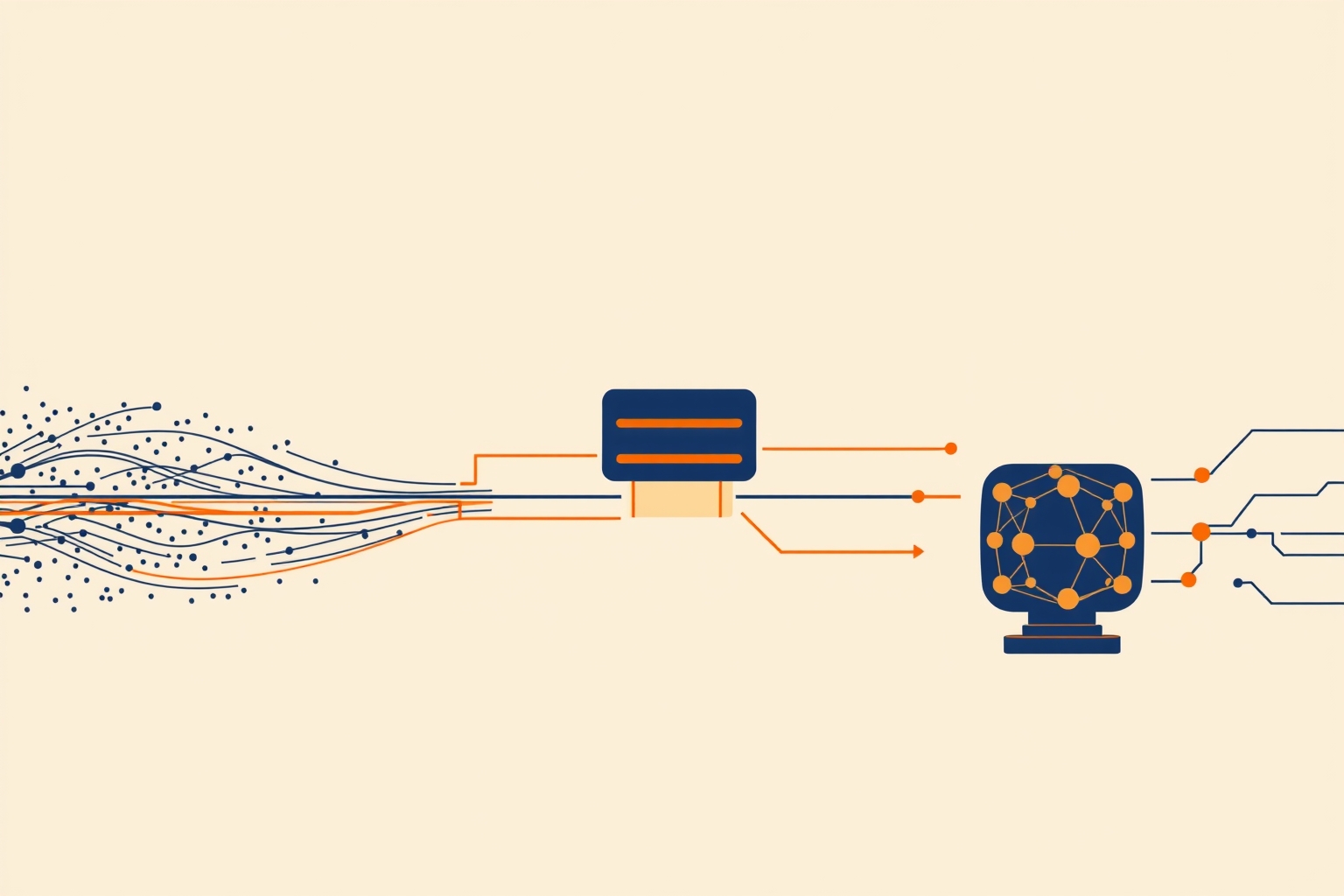
This is where streaming platforms like Apache Kafka, Apache Flink, or Spark Streaming become critical. Events flow through these systems, are transformed into features, and then immediately land in the online feature store. The process looks something like this:
- Event Ingestion: Raw events (user clicks, sensor readings, transactions) are pushed into a streaming message queue (e.g., Kafka).
- Stream Processing: A stream processing engine (e.g., Flink, Spark Streaming, Kafka Streams) consumes these events. It applies the defined feature transformations – aggregations, windowing functions, joins – to compute the real-time features.
- Feature Materialization: The computed features are then written to the online feature store (e.g., Redis).
- Feature Serving: When an AI model needs to make a real-time prediction, it queries the online feature store for the latest feature values.
This tight loop ensures that the features are as fresh as possible when the model needs them.
The Consistency Challenge Between Training and Serving
One of the biggest headaches with real-time features is maintaining consistency between your training and serving environments. You want the feature user_recent_activity_score to be computed identically for both historical model training and live inference. If the logic differs, even subtly, your model will perform worse in production than it did during testing.
A well-designed real-time feature store addresses this by:
- Centralized Feature Definitions: Features are defined once, typically as code, in a way that can be executed by both batch (for offline historical computation) and streaming (for online real-time computation) pipelines.
- Time-Travel Capabilities: For training, you need to reconstruct feature values as they existed at a specific point in time. This prevents data leakage and ensures accurate historical context. The offline store typically handles this.
The shared definition is key. If you're using a system like Feast, for example, you define a FeatureView once, and the platform handles the materialization to both online and offline stores, often leveraging streaming processors for real-time updates.
Operational Considerations and When to Use It
Honestly, this is where things get interesting. Building and maintaining a real-time feature store with streaming data isn't trivial. It introduces significant operational complexity:
- Infrastructure: You're dealing with Kafka clusters, Flink/Spark jobs, low-latency databases. All of this needs to be managed, monitored, and scaled.
- Data Latency and Throughput: Ensuring your streaming pipelines can keep up with event volumes and deliver features with sub-100ms latency is a non-trivial engineering challenge.
- Cost: Running these distributed systems 24/7 can be expensive.
- Debugging: Tracking down issues in a complex streaming pipeline that feeds into a real-time store can be tricky.
So, when should you even consider this? I wouldn't reach for this by default. It's really for situations where:
- Low-latency predictions are critical: Fraud detection, personalized recommendations, real-time bidding, dynamic pricing.
- Features decay quickly: User session data, current market conditions, immediate contextual information.
- Training-serving consistency is a major headache: You're already struggling to keep your offline and online feature logic aligned.
For many ML applications, batch features or near-real-time (minutes, not milliseconds) are perfectly adequate. Don't over-engineer if you don't have the explicit need.
Wrapping Up
Real-time feature stores, powered by streaming data architectures, are a powerful pattern for modern AI systems that demand freshness and consistency. They solve a real problem: getting the right features to your models at the right time, whether for training or lightning-fast inference. But this power comes with a cost in complexity and operational overhead. Understand your problem's latency requirements and feature decay rates before jumping into the deep end. For the right use case, it's an investment that can significantly improve model performance and unlock new real-time capabilities.





Comments (0)
No comments yet. Be the first to leave a comment!
Verify Your Comment
We sent a 6-digit OTP code to . Please enter the code below to publish your comment.