
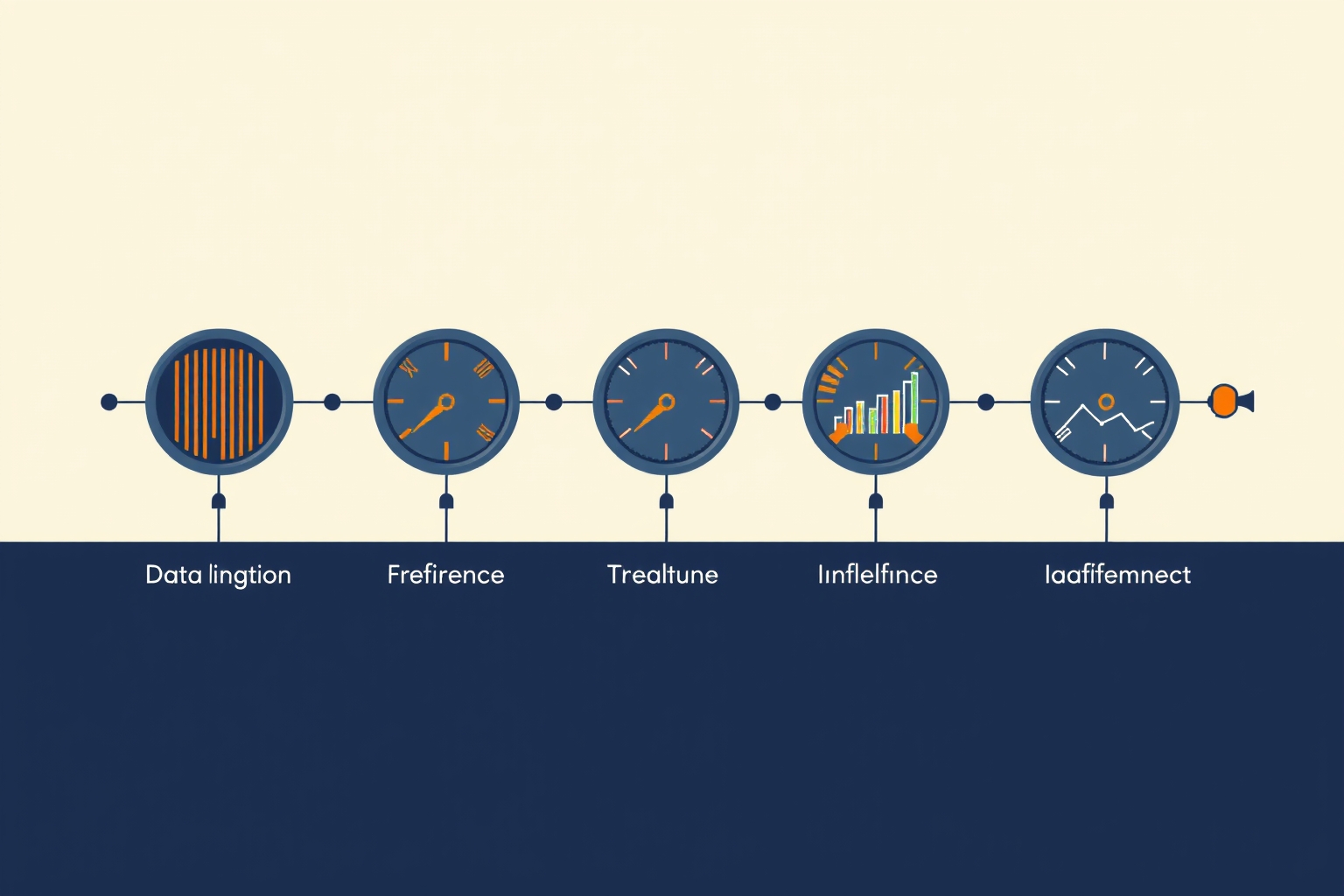
The AI/ML Observability Stack
When we talk about observing production systems, most of us think about CPU usage, memory, network latency, and application error rates. These are crucial, no doubt. But with AI and machine learning systems, those traditional metrics only tell part of the story. An ML model might be running perfectly fine on a healthy server, consuming expected resources, and still delivering terrible predictions because the data it's seeing has changed. This is where AI/ML observability needs to go deeper.
For most software, "full-stack" observability means looking at your infrastructure, application code, and maybe database performance. For AI/ML, we need to add a couple more critical layers: the data itself and the model's behavior. If you miss these, you're flying blind.
Infrastructure and Application Layer
This is the familiar territory. We're talking about monitoring the underlying compute resources (GPUs, CPUs, memory), network I/O, and the health of the application services that host your models. Are your inference endpoints responding quickly? Are there any service crashes? Are queues backing up? Standard logging, metrics, and tracing tools work great here.
- Resource Utilization: CPU, GPU, RAM, disk I/O, network throughput.
- Service Health: Latency, error rates, request queues, uptime.
- Application Logs: Errors, warnings, and informational messages from your inference servers or training jobs.
While essential, this only tells you if your infrastructure is standing. It doesn't say if it's doing useful work.
Data Layer
This is often the first place AI/ML systems start to fail silently. Models are only as good as the data they're trained on and the data they infer on. Changes in input data can completely derail a model, even if the application serving it is perfectly healthy.
- Input Data Validation: Are input schemas correct? Are all expected features present? Are there unexpected nulls or out-of-range values?
- Data Drift: Has the distribution of your input features shifted significantly from the training data? For example, if your model was trained on mostly daytime traffic data, but now it's seeing a lot of night-time data, its performance might degrade.
- Data Freshness: For models that rely on frequently updated features, how old is the data they're using?
- Training Data Integrity: If you're continuously retraining, how healthy is your new training data? Are there anomalies or corruptions?
Monitoring data quality at ingestion and throughout your pipelines is crucial. If the data is bad, the model's output will be bad, regardless of its internal state.
Model Layer
This is where the unique challenges of AI/ML observability really shine. You need to understand how your model is performing, not just how fast it's running. This means looking at prediction quality and understanding why it makes certain decisions.
- Prediction Performance: This is key. For classification models, think precision, recall, F1-score. For regression, RMSE or MAE. It's not always straightforward to calculate this in real-time, especially if ground truth isn't immediately available. Often, you need to rely on proxy metrics or a delayed feedback loop.
- Model Drift (Concept Drift): Beyond data drift, concept drift means the relationship between input features and target predictions has changed. The world itself has evolved, and your model's learned patterns are no longer accurate. This is harder to detect than data drift and often requires more sophisticated statistical methods or comparing model outputs to a "champion/challenger" setup.
- Bias and Fairness: Is your model performing differently for different subgroups of users? Are certain demographics consistently receiving worse predictions? This is a critical ethical and practical concern.
- Explainability (XAI): Why did the model make a particular prediction? Tools that help understand feature importance (like SHAP or LIME) can be invaluable for debugging unexpected behavior and building trust.
Honestly, this is where things get interesting. You might have perfect infrastructure and clean data, but if your model is drifting, your users are still getting a bad experience.
Putting it All Together
The annoying part is that these layers aren't isolated. A data drift might cause a drop in model performance, which then might lead to increased application errors if downstream systems can't handle the unexpected model outputs. A full-stack view means correlating signals across all these layers.
This usually involves:
- Unified Dashboards: Bringing infrastructure, application, data, and model metrics into a single pane of glass.
- Alerting: Setting up thresholds for anomalies at each layer, with intelligent routing.
- Root Cause Analysis: Having the ability to drill down from a high-level performance drop to specific data shifts or model output changes.
You probably won't find one single tool that does all of this perfectly for every stack. It's often a combination of traditional monitoring solutions (Prometheus, Grafana, Datadog) augmented by specialized MLOps platforms or custom-built data quality checks and model performance dashboards.
Final Thoughts
Building effective observability for AI/ML systems is more complex than for traditional applications, primarily because of the dynamic nature of data and models. It requires thinking beyond just uptime and latency. Focus on monitoring your data quality, detecting shifts in input distributions, and continuously evaluating your model's prediction performance in the wild. Ignoring these layers means you're just hoping your AI is working, not knowing it.
I wouldn't assume this is easy, but investing in robust AI/ML observability from the start can save a lot of headaches, and potentially a lot of money, down the line.





Comments (0)
No comments yet. Be the first to leave a comment!
Verify Your Comment
We sent a 6-digit OTP code to . Please enter the code below to publish your comment.