
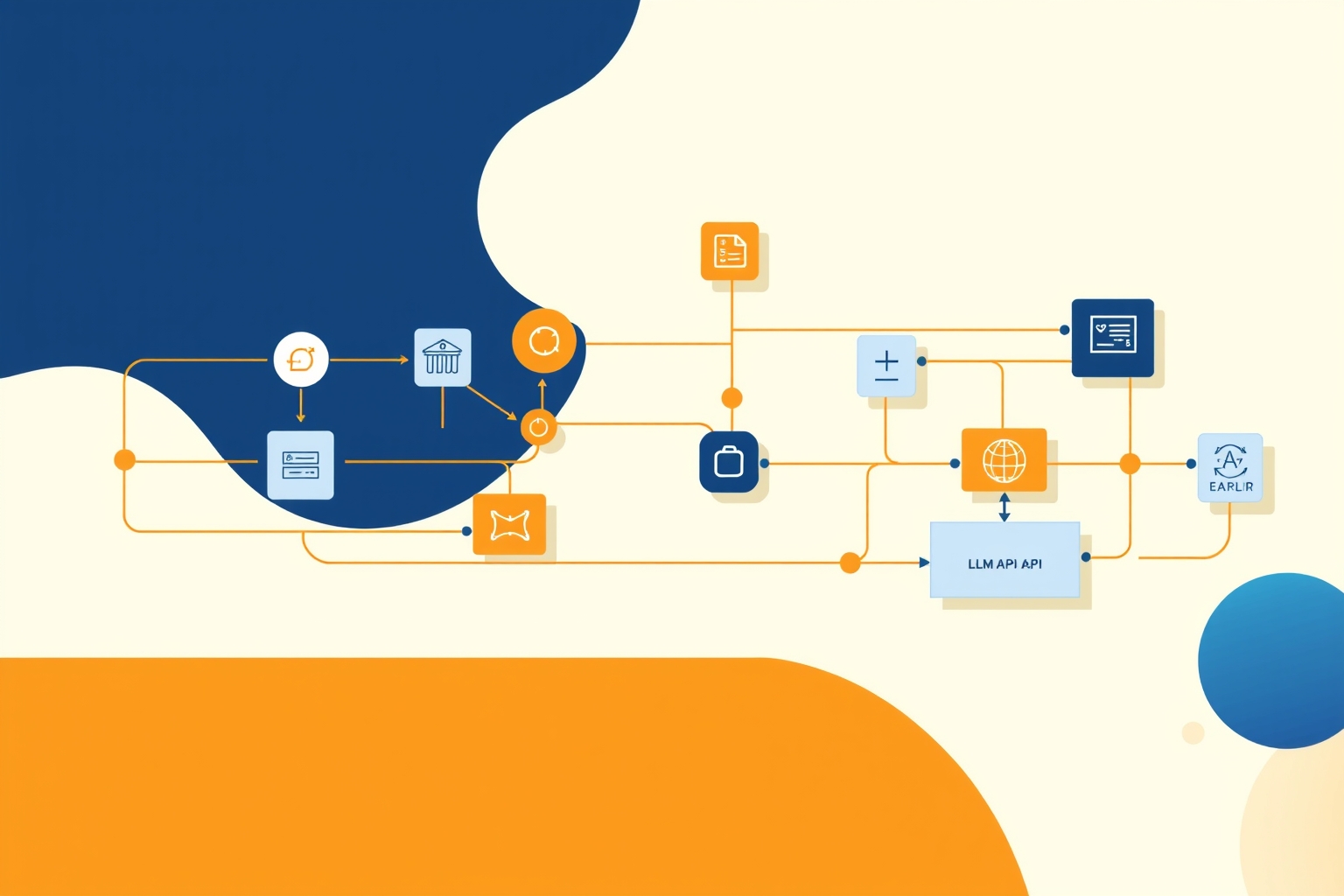
The Problem with Stateless LLM Chains
Working with Large Language Models quickly moves beyond simple single-shot API calls. Real-world applications often involve a sequence of operations: one prompt generates a draft, another refines it, a third summarizes, maybe a moderation check happens in between. This isn't just a linear pipeline; it can involve conditional branching based on LLM output, retries for transient API errors, or even human approvals.
The challenge comes when you want to run these complex workflows in a serverless environment. Serverless functions, like AWS Lambda or Azure Functions, are inherently stateless. Each invocation is a fresh start. Managing the state, progress, and error handling across multiple function calls for a single, long-running LLM workflow quickly becomes a headache. You can pass state via function inputs, but that gets messy and error-prone for anything beyond two or three steps. This is where dedicated orchestration patterns become essential.
Why Orchestration Matters Here
Without proper orchestration, managing complex LLM workflows in serverless means you're building a lot of boilerplate code:
- State Management: How do you know which step is next? Where's the output from the previous LLM call stored?
- Error Handling and Retries: LLM APIs can be flaky. How do you retry a failed step without restarting the whole workflow?
- Conditional Logic: If an LLM output needs refinement, how do you direct the flow to a specific 'refine' step?
- Long-running Processes: Some workflows might take minutes, or even hours if human interaction is involved. Serverless functions have execution limits.
- Observability: Debugging a multi-step process spread across several independent functions is tough without a central view.
Orchestration tools solve these problems by providing a framework to define, execute, and monitor stateful workflows. They handle the transitions, retries, and state persistence for you, letting your individual serverless functions focus on their single task.
Common Serverless Orchestration Patterns
There isn't a one-size-fits-all solution. The right pattern depends on the complexity, duration, and reliability requirements of your LLM workflow.
State Machines for Explicit Workflows
Services like AWS Step Functions or Azure Durable Functions are purpose-built for defining stateful workflows. You model your LLM process as a series of states and transitions. Each state can be a serverless function invocation, an API call, or a conditional choice.
{
  "Comment": "LLM Document Processing Workflow",
  "StartAt": "ExtractKeywords",
  "States": {
    "ExtractKeywords": {
      "Type": "Task",
      "Resource": "arn:aws:lambda:REGION:ACCOUNT_ID:function:ExtractKeywordsFunction",
      "Next": "GenerateSummary"
    },
    "GenerateSummary": {
      "Type": "Task",
      "Resource": "arn:aws:lambda:REGION:ACCOUNT_ID:function:GenerateSummaryFunction",
      "Catch": [
        {
          "ErrorEquals": ["States.TaskFailed"],
          "Next": "HandleSummaryFailure"
        }
      ],
      "Next": "ReviewOutput"
    },
    "ReviewOutput": {
      "Type": "Choice",
      "Choices": [
        {
          "Variable": "$.summary_quality",
          "StringEquals": "Good",
          "Next": "PublishResult"
        },
        {
          "Variable": "$.summary_quality",
          "StringEquals": "NeedsRefinement",
          "Next": "RefineSummary"
        }
      ],
      "Default": "HumanReview"
    },
    "RefineSummary": {
      "Type": "Task",
      "Resource": "arn:aws:lambda:REGION:ACCOUNT_ID:function:RefineSummaryFunction",
      "Next": "ReviewOutput"
    },
    "PublishResult": {
      "Type": "Task",
      "Resource": "arn:aws:lambda:REGION:ACCOUNT_ID:function:PublishResultFunction",
      "End": true
    },
    "HandleSummaryFailure": {
      "Type": "Task",
      "Resource": "arn:aws:lambda:REGION:ACCOUNT_ID:function:NotifyFailureFunction",
      "End": true
    },
    "HumanReview": {
      "Type": "Task",
      "Resource": "arn:aws:lambda:REGION:ACCOUNT_ID:activity:HumanReviewActivity",
      "Next": "ReviewOutput"
    }
  }
}
This declarative approach makes the workflow's structure visible and easy to reason about. They inherently manage state, retries with backoff, and timeouts. For complex, long-running, or human-in-the-loop LLM tasks, state machines are often a solid choice. The downside can be vendor lock-in and a steeper learning curve compared to simple function chaining.
Queue and Event-Driven Patterns
For simpler, more decoupled LLM workflows, a queue-based approach can work well. Each step of the workflow is an independent serverless function. When a function completes its task (e.g., generating initial LLM output), it publishes a message to a queue or an event stream (like AWS SQS, Kafka, or EventBridge). The next function in the chain subscribes to that queue/stream and processes the message.
- Decoupling: Each step is independent, making it easier to develop and deploy.
- Scalability: Queues naturally handle spikes in workload.
- Resilience: Messages can be retried if a downstream function fails, up to a certain point.
This pattern is great for fan-out scenarios (e.g., process a document, then generate multiple summaries in parallel for different audiences). The annoying part is managing the overall workflow state and ensuring all parallel branches complete before moving to the next stage (fan-in). You might need a separate mechanism, like a database entry or a custom counter, to track global progress. For simple linear workflows or highly parallel, independent tasks, this is often simpler to set up initially.
Dedicated Workflow Engines
For extremely complex, highly durable, and potentially very long-running LLM workflows that might span days or involve complex compensation logic, dedicated workflow engines like Temporal or Cadence offer even more power. These systems allow you to write your workflow logic directly in code (e.g., Python, Go, Java) while the engine handles state persistence, retries, timers, and even guarantees execution despite infrastructure failures.
They're essentially a more robust, self-hosted alternative to managed state machine services, offering greater flexibility and less vendor lock-in, but with the added operational overhead of managing the engine itself. You're trading managed service simplicity for ultimate control and durability.
Choosing the Right Pattern
When you're deciding how to orchestrate your LLM workflow in serverless, consider these points:
- Complexity: Is it a simple A->B->C flow, or does it have multiple branches, loops, and human interaction?
- Durability: Does the workflow need to survive infrastructure outages or function timeouts?
- Latency: How sensitive is the end-to-end latency? Orchestration adds some overhead.
- Observability: How easily can you track the progress of a single workflow instance and debug failures?
- Operational Overhead: Are you comfortable managing a self-hosted workflow engine, or do you prefer a managed service?
- Cost: Different services have different pricing models, especially for long-running workflows.
For simple, mostly linear LLM chains, passing state directly or using a queue for decoupling might be enough. When you hit conditional logic, retries, parallel execution, or need a clear visual representation of your business process, a state machine service like AWS Step Functions becomes much more appealing. If your LLM workflow involves complex sagas, human approval steps that might take days, or requires extreme durability guarantees with maximal control, then a dedicated workflow engine is worth considering.
Final Thoughts
The power of LLMs in applications isn't just about the model; it's about how you integrate and manage the surrounding logic. Serverless functions are great for the individual steps, but they need a strategy for coordination. Don't try to reinvent state management in your Lambda functions. Lean on established orchestration patterns and services. They provide the structure, resilience, and observability you'll need to build robust LLM-powered systems that actually work in production.





Comments (0)
No comments yet. Be the first to leave a comment!
Verify Your Comment
We sent a 6-digit OTP code to . Please enter the code below to publish your comment.