
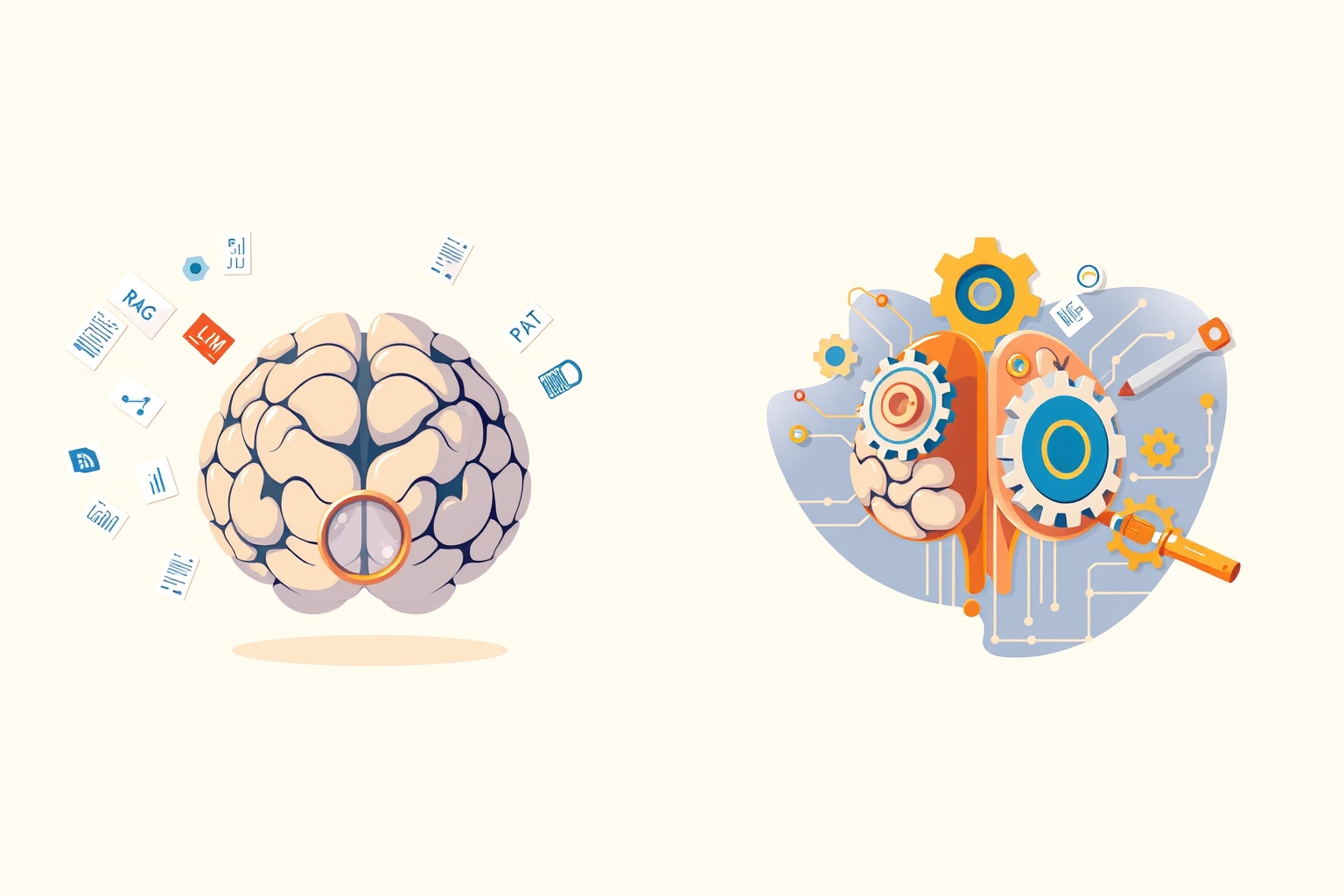
When you're building with Large Language Models (LLMs), RAG (Retrieval Augmented Generation) is often the first, and best, answer for giving the model up-to-date or domain-specific knowledge. It's elegant: fetch relevant documents, stick them into the prompt context, and let the LLM generate a response. It keeps the core model general-purpose, and you only update your retrieval index. That sounds great on paper, and for many use cases, it absolutely is.
There's a catch, though. There are times when simply retrieving documents and stuffing them into the prompt isn't enough. RAG has its limits, and understanding them is key to knowing when you need to take a deeper dive into fine-tuning.
RAG's Strengths and Where It Falls Short
RAG shines when the information you need is well-contained in documents, and the LLM just needs to reference it. Think Q&A over a knowledge base, summarizing recent news, or pulling facts from a product catalog. Its main advantages are:
- Freshness: You can update your knowledge base constantly without retraining the LLM.
- Reduced Hallucination: By grounding the model in specific documents, it's less likely to make things up (in theory).
- Explainability: You can often show the user exactly which source documents led to the answer.
However, RAG doesn't teach the LLM new behaviors or reasoning patterns. The model's fundamental understanding of language, its tone, its ability to follow complex instructions, or generate content in a very specific format remains largely unchanged. It's still using its pre-trained knowledge to interpret the retrieved context. This is where it starts to fall short:
- Stylistic Generation: If you need the LLM to write in a very specific brand voice, or generate code in a particular framework's style, RAG alone won't get you there.
- Complex Reasoning over Domain Data: For tasks that require inferring complex relationships, multi-step logical deductions within a domain, or understanding highly nuanced jargon beyond just looking up definitions, RAG might struggle. The base model still needs to have the underlying reasoning capabilities, and the context window might not be large enough for all the necessary information.
- Strict Output Formats: Generating JSON, XML, or specific code structures reliably can be hit-or-miss with RAG. The model might often deviate, requiring heavy prompt engineering and post-processing.
- Reducing Hallucination on Core Facts: While RAG aims to reduce hallucination, the model can still misinterpret retrieved documents or prioritize its general knowledge over the specific context provided. If a core concept is frequently hallucinated, RAG might not fully fix it.
- Context Window Limitations: Even with large context windows, there's a limit to how much information you can shove into a prompt. For incredibly dense or broad domain knowledge, RAG can hit a wall.
What Fine-Tuning Actually Does
Fine-tuning is about adapting the pre-trained LLM's weights to a specific task or dataset. Instead of just giving it more context, you're actually changing how the model processes information and generates responses. It's like teaching an expert a new accent or a highly specialized skill, rather than just handing them a new textbook. The model learns to:
- Adopt a Specific Style/Tone: It can learn to generate text in a particular brand voice, a technical writing style, or even mimic a specific character.
- Improve Domain-Specific Reasoning: With enough examples, it can improve its ability to reason about concepts and relationships unique to your domain, beyond what general pre-training covered.
- Adhere to Strict Output Formats: Fine-tuning can make models much more reliable at generating structured outputs like JSON, SQL queries, or specific code snippets, reducing the need for extensive prompt engineering.
- Reduce Hallucination of Core Facts: By repeatedly showing correct domain-specific facts during fine-tuning, the model can internalize them better, making it less prone to hallucinate on those specific points.
- Handle Ambiguity: For specific domain queries, a fine-tuned model might better understand the intent and generate more precise answers, even with less explicit prompting.
When to Reach for Fine-Tuning
I wouldn't reach for fine-tuning by default. It's an investment. But it makes sense in a few key scenarios:
- High-Fidelity Style and Tone: You need outputs that consistently match a very particular brand voice, legal jargon, or a specific creative writing style.
- Complex Domain-Specific Reasoning: Your application requires the LLM to perform intricate logical steps or draw conclusions based on highly specialized domain knowledge that isn't just about fact retrieval.
- Reliable Structured Output Generation: When generating code, API calls, database queries, or structured data (JSON, XML) needs to be highly accurate and consistent, reducing parsing errors downstream.
- Mitigating Persistent Hallucinations: If RAG isn't sufficiently reducing hallucinations on critical domain facts, fine-tuning can help reinforce correct information.
- Improving Instruction Following: For very specific, multi-step instructions that a base model struggles with, fine-tuning with examples can significantly improve performance.
- Small, Focused Contexts: Sometimes, the information density needed is low, but the *way* the information is processed needs to be highly specialized. Fine-tuning can make the model more efficient in these cases.
The Tradeoffs: Why It's Not Always the Answer
Fine-tuning isn't a silver bullet. It comes with its own set of challenges:
- Data Requirements: You need a high-quality, task-specific dataset. This often means carefully curated examples of prompts and desired responses. Creating this data can be expensive and time-consuming.
- Compute Costs: While not as expensive as pre-training, fine-tuning still requires significant computational resources, especially for larger models and extensive datasets.
- Operational Complexity: Managing fine-tuned models adds complexity. You need to handle versioning, deployment, and monitoring for drift.
- Model Drift: As your domain evolves, your fine-tuned model might become outdated. You'll need a strategy for periodic re-tuning.
- Overfitting: With a small or poorly curated dataset, you risk overfitting the model to your training data, making it perform poorly on unseen examples.
Making the Call: RAG First, Fine-Tune When Necessary
The practical approach usually starts with RAG. It's simpler, cheaper to maintain, and often good enough. Build your RAG system, evaluate its performance on your target tasks, and pinpoint its specific shortcomings.
If you find the LLM consistently struggles with generating the correct *style*, adhering to *formats*, performing *complex reasoning* within your domain, or repeatedly *hallucinates* on critical, static information, then it's time to seriously consider fine-tuning. It's a bigger commitment, but for those specific, high-value tasks, it can make a significant difference in output quality and reliability.
Ultimately, it's about identifying where the base LLM's general capabilities meet the specific demands of your application. RAG extends its knowledge; fine-tuning refines its very behavior.






Comments (0)
No comments yet. Be the first to leave a comment!
Verify Your Comment
We sent a 6-digit OTP code to . Please enter the code below to publish your comment.